
If Autonomy Relies on Remote Assistance, is it Truly Safe?
Welcome to Smart Mobility Spotlight, Imagry’s newsletter delivering the latest in autonomous driving and smart mobility solutions. Subscribe to stay informed with curated insights, expert perspectives, and emerging trends in the ever-evolving world of transportation.
Remote Assistance, Regulation, and the Future of Autonomy
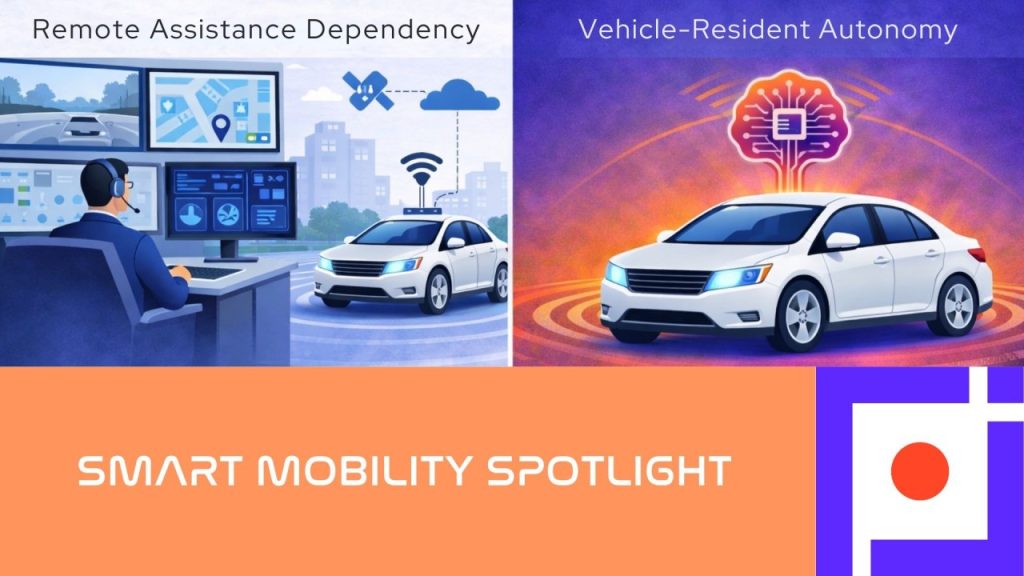
| Key Takeaways: • What is Senator Markey investigating with regard to autonomous vehicles? • What does remote intervention of autonomous vehicles mean for safety, trust, regulation, and long-term scalability? • How does remote assistance dependency compare with vehicle-resident autonomy? |
On February 3, 2026, Senator Edward J. Markey announced a formal investigation into the use of Remote Assistance Operators (RAOs) by leading autonomous vehicle companies including Waymo, Tesla, Zoox, Aurora, Motional, May Mobility, and Nuro.
The investigation focuses on fundamental operational questions:
- Who are these remote operators?
- Where are the remote personnel located?
- How frequently do they intervene?
- What authority do they hold?
- What safeguards govern their actions?
Senator Markey emphasized that AV firms rely on remote human operators while providing limited transparency about their roles and security protections. He warned that without stronger safeguards, remote operations may introduce “serious safety, national security, and privacy risks,” particularly when conducted overseas.
The following day, during a Senate Commerce hearing, Waymo confirmed that “fleet response agents” located in both the United States and the Philippines provide contextual guidance to vehicles, while maintaining that the automated system remains responsible for steering and braking decisions. Senator Markey responded by noting that the public “knows almost nothing about those people,” raising concerns about transparency, latency, and cybersecurity exposure when overseas operators influence U.S. vehicles.
This moment marks more than a political inquiry. It poses a deeper architectural question: If autonomy depends on remote human intervention, is it truly autonomous, and what does that mean for safety, trust, regulation, and long-term scalability?
⚖️ When Supervision Becomes Dependency
The formal oversight letter issued by Senator Markey distinguishes between operators who provide guidance to the automated driving system and those who directly control steering, braking, and/or acceleration
Companies maintain that remote personnel do not “drive” the vehicle but instead provide context when the system encounters uncertainty. Yet from a regulatory and operational standpoint, the more consequential question is structural. Is remote assistance a rare supervisory layer, or is it an architectural dependency embedded into the operational model?
In November 2023, transportation journalist Andrew J. Hawkins reported in The Verge that Cruise vehicles were being remotely assisted approximately 2–4 percent of the time in complex urban environments, according to statements from the company’s CEO. That figure is operationally significant. It suggests that remote intervention is not an edge-case anomaly but an ongoing component of service delivery.
Experts quoted in the article described remote assistance as one of the “hidden challenges” of automated ride-hailing — not only from a safety standpoint (as it introduces latency into the system), but from a business model and transparency perspective as well. If real-time human review remains necessary, this driving mode cannot be considered fully autonomous.
🔐 Safety Boundaries, Cybersecurity, and Latency
Remote assistance expands the operational boundary of the vehicle. In many architectures, this involves teleoperation — the ability for a human operator located off-board to influence or control a vehicle’s behavior through a live communication network, either by providing real-time guidance or, in some cases, direct control.
When teleoperation becomes part of the operational model, communication links, remote control interfaces, operator centers, and cross-border data flows effectively become components of the safety-critical system. These elements must therefore be secured as rigorously as the vehicle itself.
The Markey investigation explicitly raises concerns that overseas remote centers may increase cybersecurity and interference risks. Industry reporting published in EE Times | Electronic Engineering Times described teleoperation as exposing a direct control interface to the vehicle and emphasized that such architectures require layered end-to-end security, secure authentication, and fail-safe behavior in case of communication disruption.
The same reporting noted that latency remains a structural constraint. While roughly 100 milliseconds may be workable for low-speed environments, higher-speed applications demand significantly lower latency. Human factors research summarized in CHI 2022 findings reports that remote operators experience degraded performance when latency exceeds roughly 200–250 milliseconds.
There is currently no unified federal latency or remote intervention standard governing AV operations in the United States.
For transit agencies and fleet operators, the implication is structural. When autonomy depends on connectivity and remote personnel, safety and compliance extend beyond the vehicle into telecommunications infrastructure and cybersecurity architecture. That distribution of risk directly affects operational resilience and scalability.

🧠 Architecture as a Strategic Differentiator: Imagry’s Approach
At Imagry, our autonomy stack is designed as a fully vehicle-resident system. Our HD-mapless, camera-based AI platform performs real-time perception, scene understanding, behavioral prediction, and motion planning locally within the vehicle. The system learns optimal driving behavior rather than relying on pre-mapped routes or remote guidance to resolve uncertainty.
Because the dynamic driving task remains self-contained onboard in the Imagry solution, the safety-critical control loop does not depend on remote human intervention or continuous connectivity. External networks may support fleet visibility and diagnostics, but they are not embedded into real-time vehicle control. This keeps latency at a minimum, limits remote control pathways, and clearly defines accountability boundaries.
The Imagry approach aligns with the UNR-155 cybersecurity framework, which requires protection against unauthorized remote control and external interference. As regulatory scrutiny increases, the distinction between remote supervision and remote dependency becomes operationally significant.
Autonomous Mobility Video Spotlight
In January 2026 Imagry participated at the annual Automotive World exhibition in Tokyo, Japan. Imagry’s CEO provided this brief video overview of the autonomous bus as a solution to the bus driver shortage and underserved populations seeking mobility in Japan. In the video above, the English presentation is supported by an onsite Japanese translation and slides in Japanese.
Autonomous Mobility News & Events
Click here to see the latest news and events featuring Imagry’s autonomous driving solutions.
Autonomous Mobility Career Opportunities
We’re building more than autonomy. We’re building a team that dares to do what others say is impossible.
We value people who chase hard problems not credit. Who ask better questions. Who stay curious. Who care about the mission, not job titles. And we know that to build the future, we need all kinds of minds.
If that sounds like you, we’d love to meet you.
Want to receive information about automated mobility on a regular basis?
Next stop, full autonomy!
Are you coming? Got a question for us?
Company Locations
1630 Old Oakland Rd.
Suite #A112
San Jose CA 95131
USA
53 Derekh HaAtsma'ut
3rd Floor
Haifa 3303327
Israel