
The Year Physical AI Moved from Vision to Reality
Welcome to Smart Mobility Spotlight, Imagry’s newsletter delivering the latest in autonomous driving and smart mobility solutions. Subscribe to stay informed with curated insights, expert perspectives, and emerging trends in the ever-evolving world of transportation.
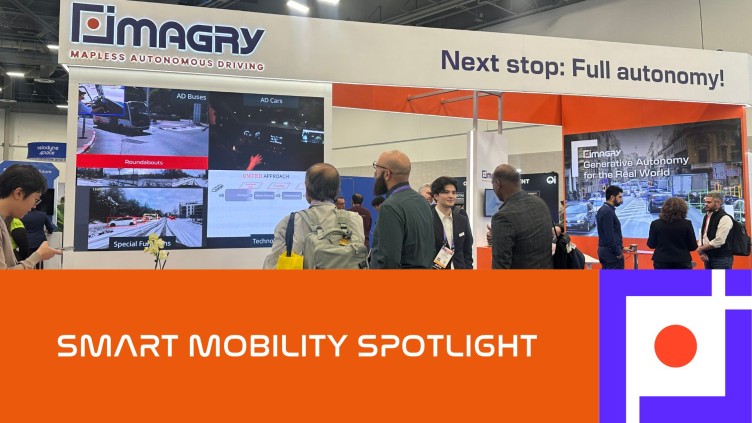
Leading Theme for Mobility at CES2026: Physical AI
| Key Takeaways: • How digital intelligence is crossing over into physical systems • Physical AI: The next major industry trend? • Key shifts observed at CES 2026 |
CES 2026 once again confirmed its role as the global stage where technology advances from concept to execution. Held January 6–9 in Las Vegas, the event brought together more than 148,000 attendees, over 4,100 exhibitors, and a strong concentration of senior decision makers across mobility, AI, robotics, and industrial technology.
This year, one theme clearly stood out: Physical AI. Not AI as a digital assistant or analytics layer, but AI systems that perceive, reason, and act in the real world. Across the show floor, in keynotes, and in policy discussions, the industry focus shifted from what AI could theoretically do to how it performs in everyday, real-world environments.
From Digital Intelligence to Physical Systems
CES 2026 highlighted a clear transition away from isolated AI capabilities toward integrated systems operating in dynamic physical environments. The conversation moved beyond model accuracy and benchmarks toward operational questions:
- Can AI adapt in real time to changing environments?
- Can AI operate safely and consistently in unexpected scenarios?
- Can AI earn trust through predictable, repeatable behavior in daily operation?
This shift was especially visible in autonomous mobility, robotics, and industrial automation, where performance is measured by reliability in the field rather than results in controlled demos.
McKinsey & Company recently emphasized this broader transformation, describing how organizations must reinvent themselves to compete in an AI-driven future where digital intelligence increasingly meets the physical world.
Physical AI as an Industry Trend
One of the defining themes of CES 2026 was the rise of Physical AI as an industry-wide direction. Across keynotes and exhibits, companies emphasized the need for AI systems that can operate reliably in real-world, safety-critical environments.
As autonomous systems and robotics scale, the discussion increasingly focused on the practical requirements of deployment, including system robustness, real-time performance, and the ability to operate continuously under changing conditions. The industry message was clear: real-world autonomy depends not only on algorithms, but on mature system integration and operational readiness that can support consistent performance at scale.
Within this broader context, NVIDIA introduced Vera Rubin, its next-generation compute platform designed to address the growing demands of real-time AI workloads. As autonomous systems scale, compute performance and efficiency are becoming important enablers for deployment in safety-critical environments. Side note: Imagry was the first autonomous driving software developer to use the NVIDIA platform to support AI-based technology operating L3 vehicles on public roads.
Mobility at CES 2026: Beyond the Private Car
Mobility innovation at CES 2026 extended far beyond consumer vehicles, with a strong focus on fleet operations, public transport, and industrial applications.
Across the Mobility Stage and West Hall, companies such as BMW, Qualcomm, Sony Honda Mobility, John Deere, and Oshkosh Corporation showcased how autonomy, AI, and software-defined architectures are reshaping transportation at scale. As highlighted in CES 2026 mobility and vehicle technology highlights, the emphasis was on systems designed to operate reliably across diverse environments.
Key Shifts Observed at CES 2026
- Software-defined vehicles replacing hardware-centric design
- Real-time adaptation to traffic, weather, and operational conditions
- A strong focus on fleet operations, uptime, and scalability
These developments position autonomy as infrastructure rather than novelty.
Physical AI Beyond Mobility: Robotics and Industry
The Physical AI narrative extended beyond transportation into robotics and industrial automation.
Companies such as Siemens demonstrated how industrial AI and robotics innovations at CES 2026 are enabling closed-loop systems that connect simulation, operations, and optimization. These systems allow machines to learn not only from data, but from continuous interaction with real-world environments.
Across the show floor, robotics exhibits emphasized adaptability, resilience, and real-world performance, reinforcing the idea that Physical AI must function reliably outside controlled settings.
Strategic Takeaways for B2B Leaders
CES 2026 delivered several clear signals for decision makers, along with practical implications:
- Physical AI is becoming a competitive requirement, not an experiment
- Reasoning-based systems are essential for handling real-world complexity
- Open ecosystems accelerate innovation but increase integration demands
- Trust and operational reliability are now core differentiators
What this means in practice:
- Invest in AI systems that can be validated in real-world conditions
- Prioritize deployment readiness and safety processes alongside model development
- Build partnerships that support long-term scalability, not short-term pilots
- Treat autonomy as an operational system, not just a technology feature
Imagry’s Perspective: From the Booth to Real-World Deployment
CES 2026 was not only a moment to observe industry trends for Imagry. Imagry | Autonomous Driving. Throughout the week, Imagry was present on the show floor with a booth in the West Hall, engaging directly with investors, potential customers, partners, analysts, and media.
Across four intensive days, one theme consistently surfaced in conversations at the Imagry booth: the industry is shifting from theoretical autonomy toward real-world, scalable deployment of autonomous public transport. Questions focused less on future promises and more on operational readiness, safety validation, and everyday performance.
Visitors showed strong interest in Imagry’s AI-based, LiDAR-free, HD-mapless approach and how it enables reliable deployment without heavy infrastructure dependencies. These discussions closely mirrored the broader CES narrative around Physical AI, where performance, trust, and consistency matter more than controlled demonstrations.

Imagry also participated in the AV Policy Forum at CES 2026, organized by the Consumer Technology Association and Partners for Automated Vehicle Education (PAVE). The forum reinforced a message that strongly aligns with Imagry’s approach: trust in autonomous systems is built through transparency, lived experience, and real-world interaction.
As CES 2026 came to a close, the momentum continued. The next stop is Automotive World 2026 in Tokyo, where Imagry will keep advancing conversations around scalable, real-world autonomous public transport.
CES may be over, but the work of deploying trusted autonomous mobility at scale continues.
Autonomous Mobility Video Spotlight
If you missed CES this year, or just want a refresher of what was going on in the Imagry booth, take a look at this recap. It contains interviews with Imagry’s CEO, CTO, European Sales Director, and Marketing Director, as well as scenes from the company’s booth and the event itself.
Autonomous Mobility News & Events
Click here to see the latest news and events featuring Imagry’s autonomous driving solutions.
Autonomous Mobility Career Opportunities
We’re building more than autonomy. We’re building a team that dares to do what others say is impossible.
We value people who chase hard problems not credit. Who ask better questions. Who stay curious. Who care about the mission, not job titles. And we know that to build the future, we need all kinds of minds.
If that sounds like you, we’d love to meet you.
Want to receive information about automated mobility on a regular basis?
Next stop, full autonomy!
Are you coming? Got a question for us?
Company Locations
1630 Oakland Rd.
Suite #A112
San Jose CA 95131
USA
53 Derekh HaAtsma'ut
5th Floor
Haifa 3303327
Israel