
Why Does Domestic Manufacturing Shape Autonomous Transit in the U.S.?
Welcome to Smart Mobility Spotlight, Imagry’s newsletter delivering the latest in autonomous driving and smart mobility solutions. Subscribe to stay informed with curated insights, expert perspectives, and emerging trends in the ever-evolving world of transportation.
| Key Takeaways: • What does it take for an autonomous bus or shuttle to qualify for federal funding? • Why do domestic manufacturing requirements create challenges for autonomous transit projects? • Why are Buy America-compliant, automation-ready vehicles still limited in the U.S.? • What did transit agencies and operators share with Imagry at APTA EXPO 2026? • How is Imagry addressing compliance while helping agencies deploy autonomous transit? |
Insights from APTA 2026
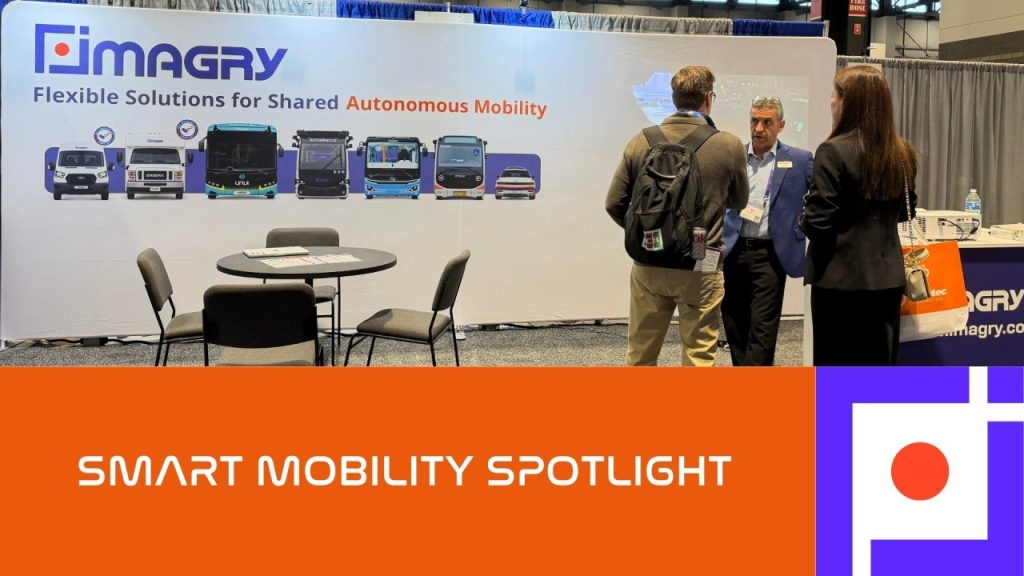
From October 4 to 7, American Public Transportation Association‘s TRANSform & EXPO brought the North American public transportation industry to McCormick Place in Chicago. The event is the largest public transportation showcase in the world, with more than 12,000 attendees from 85 countries and over 800 exhibiting companies. Imagry Autonomous Buses exhibited at Booth #4642, represented by CEO Eran Ofir, Director of Bus Programs Slava Ostrovsky, and Ilana Tenberg from our marketing team.
Autonomous technology appeared across the show floor, from vehicle displays to conference sessions. Yet many of the conversations at our booth came back to a question that concerns PTOs (Public Transportation Operators) more than the technology itself: can a transit agency actually buy an autonomous vehicle with federal funds? For U.S. agencies, the answer depends on federal rules about where a vehicle is made. Which raises a question worth examining more closely: why do domestic manufacturing rules shape the path of autonomous transit in the U.S., and what did APTA EXPO reveal about where the market is heading?

What It Takes to Qualify for Federal Funds
Picture a transit agency in a mid-sized city planning a shuttle between its train station and a hospital campus. Most of the money will come from federal grants administered by the Federal Transit Administration (FTA). Before the vehicle carries a single passenger, the agency has to show that it meets federal domestic content rules, which tie federal transit dollars to domestic manufacturing.
For buses and shuttles, the rules have two parts. More than 70 percent of the cost of the vehicle’s components must come from U.S. production, and final assembly must take place in the United States. FTA’s updated FAQ on transit bus automation, revised in 2026, confirms that these requirements apply to automated vehicles as well, including prototypes and vehicles bought for pilots and demonstration projects. In other words, there is no separate track for testing. A vehicle that does not meet the rules cannot be bought with federal funds, even for a short pilot.
FTA can waive the requirement, but only in limited circumstances: when applying it would be against the public interest, when domestic products are not available in sufficient quantity or quality, or when domestic content would raise the cost of the project by more than 25 percent. The same FAQ addresses automated vehicle components directly. Waiver requests are examined in detail, also reviewed by the Made in America Office at the White House Office of Management and Budget, and FTA states that a project sponsor should not expect a waiver to be granted. For an agency, compliance is therefore a condition for starting a project, not a detail to settle after the vehicle is chosen.
🧩 Where Agencies Get Stuck
On paper, the rules are clear. Applying them to a new technology is harder. In 2023, FTA brought together transit agency leaders to discuss the challenges of introducing automated buses, and domestic content was one of the issues they raised. Participants asked how the rules treat the hardware and software that drive the vehicle, and what counts as “final assembly” when automation is added to a vehicle that has already been built.
Agencies also described problems that had less to do with the rules themselves and more to do with the suppliers around them. Some projects were delayed or rescoped because the vendor changed between the funding application and the request for proposals. Others struggled with technology vendors who were new to federal procurement and still learning its requirements. Each of these points leads back to two questions an agency needs answered before it signs a contract: does this vehicle qualify, and will this supplier still be able to deliver it?
🏭 A Small Market With Few Ready Vehicles
Even without automation, the supply of compliant vehicles is limited. A June 2026 report from Eno Center for Transportation and CalSTRS describes a U.S. transit bus market with a shrinking number of manufacturers and relatively small volumes. Fewer than 5,000 heavy-duty transit buses are sold in a typical year, compared with nearly 16 million cars, SUVs and light trucks. The report also notes that the European bus market is about nine times larger than the U.S. market. That difference matters for autonomy. A vehicle proven in Europe or Asia cannot simply be shipped to a U.S. agency. It has to be built or assembled to meet U.S. domestic content rules, for a market that is far smaller.
The gap is visible in smaller vehicles too. In 2024, FTA concluded that no mass-produced, unmodified passenger vans or minivans of a certain type met its domestic content requirement, and extended a partial waiver for another five years. Even under that waiver, final assembly and the engine or motor must be American. Put together, these findings describe the situation agencies face: interest in autonomous service is growing, while the number of vehicles that are both automation-ready and compliant with domestic content rules remains small.
🤝 From the Booth: What We Heard at APTA
Four days of conversations with transit agencies, operators and partners gave our team a clear picture of where the U.S. market stands. A few observations stood out:
- Compliance came up early. For many agencies, domestic content compliance was one of the first questions asked, often before questions about the technology itself.
- International operators are expanding in the U.S. Several large global public transportation operators are investing in the U.S. market, and autonomous service is part of their plans.
- Demand for automation-ready vehicles exceeds supply. Agencies are looking for vehicles they can buy and put into service, and very few are available in the U.S. today.
- Specific use cases are taking shape. Conversations repeatedly returned to corporate shuttles, airport shuttles, and paratransit, the door-to-door service that agencies are required by law to provide for riders with disabilities. Interest also came from suburbs and smaller cities, where federal funding is available. Automated buses are generally eligible for the same FTA funding programs as conventional ones, including programs for rural areas and for seniors and people with disabilities.

🚍 Imagry’s Approach: Compliance Built In From the Start
Imagry Autonomous Buses offers two fully integrated autonomous vehicle options for the U.S. market, a bus and a shuttle, both running on one autonomous driving software stack:
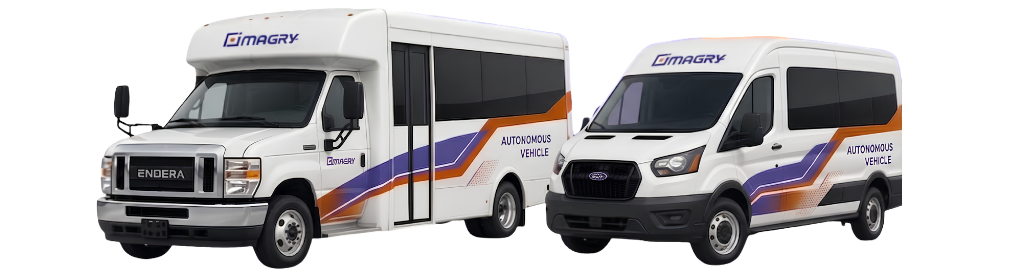
- Buy American Act compliant. Both vehicles can qualify agency projects for federal funding without waivers.
- End-to-end self-driving solution. Vehicle hardware, software and control-room interfaces are delivered as a complete, fully integrated package.
- FMVSS-certified for public and private roads. The vehicles meet federal requirements for routes on mixed-traffic public roads as well as operational zones.
- Road ready, with no traffic modifications required. Vehicles operate on existing road infrastructure, with no roadside upgrades, no depot retrofits and no agency capital expenditure.
- Lower cost per mile. No expensive sensor stacks, no HD-map license fees and no ongoing map maintenance in the operating budget.
- Room to grow service. Agencies can expand service frequency, timetables and route range without recruiting new drivers.
- Field-proven and recognized. Imagry vehicles operate in the U.S., Germany, Japan and Israel, and the company has received Frost & Sullivan “Best Practices” awards in 2023 and 2025.
APTA EXPO showed that autonomous transit in the U.S. is no longer only a question of whether the technology works. It is also a question of whether an agency can buy it, fund it and put it into service under the rules that govern public money. Those rules start with where the vehicle is made. We have already reserved a larger booth for APTA EXPO 2029 in Anaheim, California, and we look forward to continuing these conversations until then.
Imagry in the News
Click here to see the latest news and events featuring Imagry’s autonomous driving solutions.
Video Spotlight
Watch this video to learn how Imagry is bringing real-world autonomy to public transport for M3 / M2 / M1 category vehicles.
Autonomous Mobility Career Opportunities
We’re building more than autonomy. We’re building a team that dares to do what others say is impossible.
We value people who chase hard problems not credit. Who ask better questions. Who stay curious. Who care about the mission, not job titles. And we know that to build the future, we need all kinds of minds.
If that sounds like you, we’d love to meet you.
Want to receive information about automated mobility on a regular basis?
Next stop, full autonomy!
Are you coming? Got a question for us?
Company Locations
1630 Oakland Rd.
Suite #A112
San Jose CA 95131
USA
53 Derekh HaAtsma'ut
5th Floor
Haifa 3303327
Israel