
AI Autonomous Driving for Roboshuttles
| Key Takeaways |
|---|
| * Difference between roboshuttles and robotaxis |
| * Status of roboshuttle market in Europe |
| * Benefits of Imagry roboshuttle offering |
What is the difference between a Roboshuttle and a Robotaxi?
While both roboshuttles and robotaxis are autonomous passenger vehicles, roboshuttles are designed to transport passengers along predefined routes. Typically, they operate between one pickup point and one drop-off point, making them well suited for urban corridors, airport connections, and city-center circulatory beltways. These services bridge the gap between traditional public transport and on-demand mobility, offering frequent and reliable service without the operational cost of large buses or human drivers.
Robotaxis (driverless taxis), on the other hand, do not solve any of the most important challenges for urban mobility, they only compete with the existing ride-sharing services like Uber, Lyft, and yellow cabs.
- They do not provide a solution for underserved populations (they are expensive, compared to buses)
- They do not relieve urban congestion (they actually add to it!)
- They are geographically limited, because they rely on HD maps
- They do not provide good ROI due to their high cost per vehicle, a result of the technology used (multiple sensor types and broadband communication requirements)
Roboshuttles, on the other hand, follow a fixed route and are able to provide round-the-clock service to the major areas and for the passengers who need it most.
Is Shared Autonomous Mobility a Growing Market Segment in Europe?
Europe is a reminder that shared and autonomous mobility is not theoretical, but already scaling. According to Market Research Future, the European shared mobility market was valued at over USD 154 billion in 2024 and is projected to grow to more than USD 537 billion by 2035, driven by urbanization, sustainability goals, and rising demand for cost-efficient transport services.
Within this context, European cities are expanding shared mobility offerings to reduce congestion and emissions, while addressing structural challenges such as professional driver shortages and increasing operating costs.
Car-sharing and shared mobility operators are therefore well positioned to integrate autonomous driving as a white-label capability, enabling scalable services without fundamental changes to fleet models or customer experience.
Source : https://www.marketresearchfuture.com/reports/europe-shared-mobility-market-17789
The Answer: L4 Autonomous Driving for Roboshuttles
Imagry provides an HD-mapless, L4-ready autonomous driving solution designed for passenger-
car-based roboshuttles operating on public roads with mixed traffic. The solution enables:
- Fixed and semi-fixed route operation
- Cost-effective deployment without HD mapping or expensive sensors
- Scalable fleet expansion across cities and regions
- Seamless integration into existing shared mobility platforms
- White-label opportunity for car sharing fleets

Where is the First Real-World Deployment of Roboshuttles in Europe?
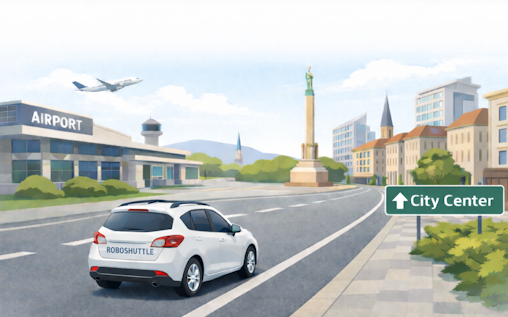
In collaboration with the Latvian car sharing service provider Carguru, the first implementation will be based on an electric-powered vehicle with capacity for up to three passengers. The route covers 9.8 kilometers on public roads with mixed traffic and will transport passengers between the Riga Airport and the Freedom Monument. With Imagry’s award-winning, AI-based perception, motion planning, and vehicle control software, the vehicles will support HD-mapless, location-independent driverless operation that is rapidly deployable and easily scalable.
This deployment demonstrates how shared mobility operators can incorporate autonomous driving to deliver safe, reliable, and sustainable transportation at scale. Read more.
Imagry’s Approach to Roboshuttle Autonomy
Imagry’s approach to roboshuttle autonomy is shaped by the practical requirements of shared mobility deployments and fleet-based operations.
Key aspects of Imagry’s approach include:
- Infrastructure-independent deployment
AI-based, HD-mapless autonomy enables rapid deployment using existing road and traffic infrastructure. - Optimized for shared mobility operations
Well suited for fixed and semi-fixed routes, high-frequency services, and multi-passenger use cases. - Cost-effective scalability
A software-centric approach that supports fleet-level growth for shared mobility operators. - White-label integration
Brand-agnostic deployment that allows operators to deliver autonomous services under their own brand while relying on Imagry’s technology stack.
Looking to bring autonomous roboshuttles into your shared mobility operations?
Get in touch to explore how autonomous driving can support your shared mobility deployment.