How Autonomous Public Transit Benefits Passengers and Communities

by Maya Amiel | Imagry
August 4, 2026

Key Takeaways 

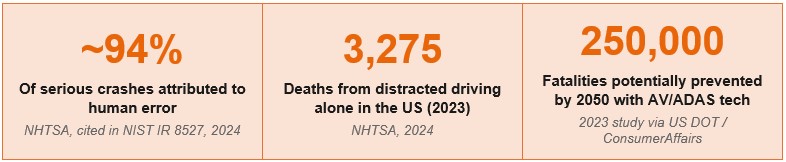
  • Approximately 94% of serious road crashes are attributed to human error — autonomous systems directly eliminate the dominant cause (NHTSA, cited in NIST IR 8527, 2024). 
  • 3,275 people died from distracted driving alone in the US in 2023; autonomous transit removes distraction, fatigue, and impairment from the equation (NHTSA, 2024). 
  • Up to 250,000 fatalities could be prevented by 2050 with AV/ADAS technology deployment at scale (2023 study via US DOT / ConsumerAffairs). 
  • The people who benefit most — the elderly, disabled, children, and those in transit deserts — are precisely those least served by today’s fixed-route systems. 
  • Real-time AV tracking has already reduced average transit wait times by 18% across 450+ North American cities (Market Growth Reports / Transit Data 2024). 

The people who benefit most from autonomous public transit are often those least well-served by today’s fixed-route systems: the elderly, the disabled, students, night-shift workers, and communities in transit deserts. For these groups, reliable, safe, accessible transit is not a convenience — it is a prerequisite for participation in everyday life. Autonomous driving technology has the potential to change what is possible for all of them. 
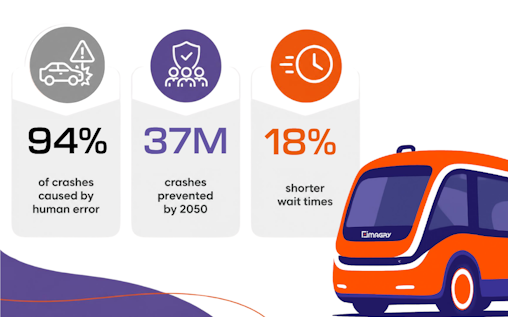
Various statistics showing benefits of autonomous buses to the public

How Does Autonomous Transit Make Journeys Safer for Passengers? 

Approximately 94% of serious road crashes are attributed to human error — distracted driving, fatigue, impairment, and misjudgment are the dominant causes of traffic accidents globally. Autonomous systems, which do not experience fatigue or distraction, directly eliminate the most common causes of road injury. 

The scale of the problem makes the potential impact significant. NHTSA’s 2024 Traffic Fatalities Report documents 40,901 total US traffic fatalities in 2023, with a significant portion attributed to distraction, speeding, and impairment — all factors autonomous systems are designed to eliminate. 

Source: NHTSA 2024, cited in NIST IR 8527 

37 million crashes could be prevented by 2050 

A 2023 study projects that ADAS and autonomous technologies could prevent approximately 37 million crashes and avert around 250,000 fatalities in the United States between 2021 and 2050. This is not a theoretical ceiling — it reflects deployment at a meaningful but achievable scale. 

Source: 2023 study via US DOT / ConsumerAffairs research 

600,000 lives over 35 years 

RAND Corporation research found that deploying AVs with even a 10% safety improvement over the average human driver could avert approximately 600,000 fatalities in the US over 35 years. The implication is that waiting for perfection costs lives — meaningful safety gains begin well before full autonomy is achieved. 

Source: RAND Corporation via PMC/Nature Communications, 2024 
Waiting for perfect autonomous technology costs lives. RAND research shows that AVs just 10% safer than the average human driver could prevent approximately 600,000 US fatalities over 35 years.

Who Benefits Most From Autonomous Public Transit? 

Safety improvements affect everyone on the road. But the accessibility benefits of autonomous transit are concentrated among specific groups who are systematically underserved by current public transit models. 

Mobility for the Elderly 

Research specifically identifies the elderly as a key group that autonomous transit can serve — enabling independent mobility for people who can no longer safely drive. In the US, one-quarter of all drivers will be over 65 by 2030, creating a growing mobility challenge that autonomous transit is well positioned to address. Maintaining independence and access to healthcare, family, and community becomes increasingly difficult without reliable transport options. 

Sources: IRU 2024; ScienceDirect AV Older Adults Study, 2020 

Access for People with Disabilities 

Multiple peer-reviewed studies identify disabled individuals as primary beneficiaries of autonomous transit — gaining on-demand, accessible mobility without the scheduling unpredictability of current paratransit systems. The WEF (2024) specifically cites disability access as a core benefit of autonomous shared transit deployment. 

Sources: WEF 2024; ScienceDirect Sustainability of AVs, 2025; CICERO/Tandfonline, 2023 

Addressing Transit Deserts 

Shared autonomous transit is identified in research as a viable solution for last-mile connectivity and underserved areas where fixed-route transit is not economically sustainable. On-demand routing can reach low-density neighborhoods that conventional services cannot serve cost-effectively — expanding the geographic footprint of reliable public transit to communities that have historically been left out. 

Sources: CICERO/Tandfonline 2023; Consensus AV Urban Mobility Review, 2025 

Children, Students, and Non-Drivers 

Autonomous transit expands safe mobility to children, students, and all those who do not or cannot hold a driver’s licence — a group identified across multiple mobility equity studies as underserved by current public transit models, especially in low-frequency or last-mile scenarios. For families without a second car, or young people in areas with infrequent service, this represents a meaningful expansion of daily mobility. 

Sources: WEF 2024; ScienceDirect AV Sustainability Review, 2025 

Will Autonomous Transit Mean More Frequent, More Reliable Service? 

Real-time tracking systems already deployed across 450+ North American cities have reduced average transit wait times by 18%. Autonomous fleets, unconstrained by shift schedules, can run at higher frequency — particularly during off-peak, late-night, and early-morning hours when driver availability is lowest and service is most often cut. 

For passengers, this means less time waiting at stops, more predictable journey times, and service that is available when it is actually needed — not just when it is operationally convenient to provide it. 

Source: Market Growth Reports / Transit Data 2024 

Autonomous fleets are unconstrained by shift schedules — enabling higher frequency service precisely during off-peak and late-night hours when driver availability is lowest and riders need it most.

Could Autonomous Transit Lead to Lower Fares? 

Labor costs represent 60–75% of transit operating budgets. Reducing this through automation creates the structural basis for lower per-passenger costs. Whether those savings translate directly into lower fares depends on operator and policy decisions — but the economic precondition for more affordable transit becomes real when the largest cost driver is reduced. 

For riders in lower-income households, for whom transit cost is a genuine barrier, this potential is meaningful. It will not happen automatically, but the technology creates the possibility in a way that the current operating model does not. 

Sources: Meticulous Research 2024; Congress.gov CRS Report R47900 

An Important Note on Safety Projections 

The safety statistics cited throughout this article reflect modelling studies and projections; real-world outcomes depend on deployment scale and technology maturity. Research also notes that autonomous vehicles are not yet proven to outperform humans in all conditions — this remains an active area of development. The benefits described here represent the direction of travel, not a guaranteed outcome at any specific point in time. 

Autonomous fleets are unconstrained by shift schedules — enabling higher frequency service precisely during off-peak and late-night hours when driver availability is lowest and riders need it most.

Next stop, full autonomy!

Are you coming? Got a question for us?

    Company Locations

    Imagry, Inc.
    1630 Oakland Rd.
    Suite #A112
    San Jose CA 95131
    USA
    Imagry (Israel) Ltd.
    53 Derekh HaAtsma'ut
    3rd Floor
    Haifa 3303327
    Israel

    Accessibility Toolbar