Are You Aware of the Effects of Robotaxi “Deadhead” Miles?
The problem runs deeper than simple oversight or neglect. Autonomous vehicles actually exacerbate the problem as robotaxis generate “deadhead” miles at scale, with empty vehicles circling between rides and adding congestion to urban streets without moving a single additional person anywhere. In 2025, deadhead miles accounted for nearly half of Waymo’s total travel in San Francisco based on data from California’s Public Utilities Commission. They didn’t contribute new mobility options to the city, only additional traffic competing with transit infrastructure already struggling to function.
Public Transportation Budgets (and Options) are Shrinking
Meanwhile, the communities most in need of new mobility options are watching their existing ones disappear. Transit agencies across the country are cutting routes and reducing service hours, not because demand has fallen, but because running low-density corridors, early-morning services, and last-mile connections to transit hubs simply costs too much to justify on current budgets. Routes on low-density corridors are always the first to go when finances tighten, and they are the ones that people with the fewest alternatives depend on most. Nevertheless, the AV industry, flush with capital and engineering capacity, has treated this as someone else’s problem.
What Happens When Public Transportation Staffing Costs are Reduced?
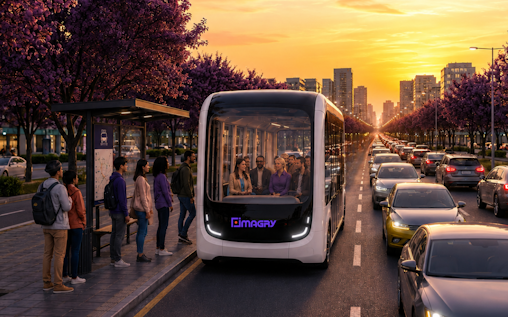
Yet, this is precisely where autonomous vehicle economics should change the outcome. The financial case for cutting a transit route rests most heavily on staffing costs. Transportation providers continue to report a persistent bus driver shortage, with one in four transit workers worldwide expected to retire by 2035. Many systems are already operating at a fraction of their required driver capacity, forcing route cuts even where ridership demand exists. At the same time, drivers are expensive, and overnight shifts on low-ridership corridors produce unit economics that no transit agency can defend when facing a budget shortfall. Remove the staffing cost, and the calculus shifts substantially. Without drivers to pay or depots to man in the early hours of the day, a bus running at 5 am on a sparse suburban corridor stops being a financial liability and becomes a service an agency can afford to sustain. Routes that transit operators couldn’t justify keeping become routes they can afford to launch.
Where are Driverless Public Transportation Solutions Proving Effective?
The evidence that this works is already accumulating. Driverless shuttles are being deployed along Atlanta’s BeltLine, connecting MARTA rail stations, university campuses, and the Lee + White district on fixed short routes designed specifically to close first-and-last-mile gaps that have long frustrated commuters. In Europe, an EU-backed initiative has launched autonomous transit trials in Oslo and Geneva, focused on integrating demand-responsive driverless vehicles directly into existing public transport networks. What remains unresolved is whether the broader industry will drive down the road where the evidence already leads.
What Will Be the Next Phase of Autonomous Vehicle Deployment?
The next phase of AV deployment is being negotiated now, in conversations between technology companies, regulators, and transit authorities, assessing whether this technology has anything practical to offer their networks. Transit operators are resource-constrained and not inclined toward optimism. They need a concrete and near-term ROI case, not a promise of transformation. Years of industry effort have gone into building that case for premium riders in high-density zip codes. Building it for the agencies that serve everyone else has barely begun.