How Does Autonomous Transit Free Up Urban Land and Reduce Parking Demand?
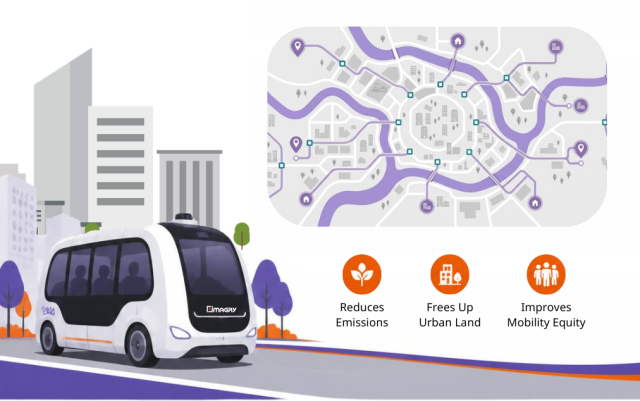
As autonomous shared transit reduces private vehicle ownership, demand for parking infrastructure declines. Research from multiple urban mobility studies shows this frees urban land for parks, housing, cycle infrastructure, and public space — improving both livability and property values. In dense city environments where land is scarce and expensive, this is a meaningful planning benefit.
The effect is most pronounced when autonomous transit is deployed as a shared network rather than as individually owned vehicles. Cities that integrate autonomous buses and shuttles into their transit mix are better positioned to capture this benefit than those that simply permit private AV ownership.
Source: Consensus Academic Review of AV Urban Impact Studies, 2025
Can Autonomous Transit Reach Underserved and Low-Density Neighborhoods?
Fixed-schedule bus systems cannot economically justify service on low-density routes. Autonomous on-demand transit changes this calculus: lower operating costs make it viable to serve routes that traditional systems cannot sustain. Shared AVs are specifically identified in research as a viable solution to last-mile connectivity challenges in underserved urban and peri-urban areas, since they:
- are economically viable on low-density routes that fixed-schedule systems cannot serve
- address last-mile connectivity in underserved urban and peri-urban areas
- are deployable without HD map prerequisites — no geographic barriers to new corridors
Sources: Tandfonline / CICERO Research, 2023; WEF Urban Mobility Report, 2024