
What’s Really Holding Mobility Innovation Back?
Welcome to Smart Mobility Spotlight, Imagry’s newsletter delivering the latest in autonomous driving and smart mobility solutions. Subscribe to stay informed with curated insights, expert perspectives, and emerging trends in the ever-evolving world of transportation.
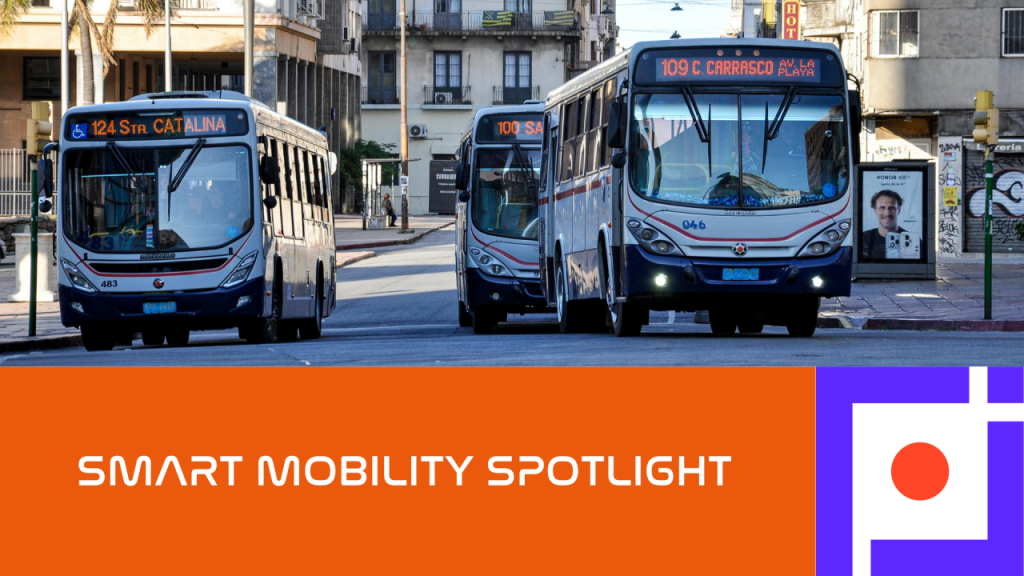
| Key Takeaways: • What are the barriers holding mobility innovation back? • How can a good ecosystem solve the autonomous transit deployment problem? • What differentiates public transportation from shared mobility solutions? • Which autonomous public transit approach best addresses city requirements? |
Last week, our team was in Milan, Italy for NME – Next Mobility Exhibition (May 13–16, 2026), the leading biennial international event dedicated to smart, integrated and sustainable passenger mobility. Over four days, we had conversations with operators, public transport authorities, manufacturers, and policymakers from across Europe and beyond — all wrestling with versions of the same challenge.
One conversation that stood out was the panel “Moving Together: Rethinking Public and Shared Mobility for Better Cities,” hosted by EIT Urban Mobility. Bringing together cities, startups, operators and policymakers, the session kept returning to a single point: mobility innovation is no longer only a technology question. It is increasingly a question of mindset, collaboration, and trust.
Which raises a question worth examining more closely: if the technology is increasingly ready, what is still standing between mobility innovation and the cities that could benefit from it?

🌍 Different Cities, Different Speeds
The panel made one thing clear early on: cities adopt innovation at very different speeds. Some embrace it openly. Others, structurally or culturally, remain more traditional in their approach.
The data backs this up. A Euronews report highlighted a telling paradox: an autonomous shuttle bus designed and built entirely in the EU is finding its biggest markets in Japan, the Middle East, and the United States, not Europe. Why? Developers point to two structural reasons: a lack of investment from both public and private sectors compared to the US and China, and a fragmented regulatory landscape. As one executive put it: “In theory, we have one European Union. In practice, when it comes to the self-driven sector, we have twenty-seven different regulations.”
The fragmentation isn’t anecdotal, it’s structural. A study published in ScienceDirect, based on a literature review and 21 semi-structured expert interviews, identified six interrelated categories of barriers to AV adoption in Europe: fragmented regulatory frameworks, unresolved ethical and legal liabilities, technological limitations and cybersecurity concerns, inadequate infrastructure, uncertain economic models, and low societal trust. Notably, only one of the six is a pure technology question.
The pattern is consistent. Countries like the Netherlands, Germany, and the UAE have built dedicated AV test zones and policy frameworks that allow operators to pilot, iterate, and scale. Others lag behind, not because the engineering is not ready, but because the ecosystem around it is not.
🛡️ Trust, Safety, and Transparency Remain the Persistent Barriers
If cities move at different speeds, the public moves at its own pace too. Trust remains one of the largest, and least mechanical, obstacles to autonomous mobility adoption.
The 2025 S&P Global Autonomous Driving Consumer Survey, which polled nearly 8,000 respondents across eight countries, found a cautiously optimistic public: roughly two-thirds of respondents expressed interest in autonomous features for highway driving, but full trust in self-driving technology remains some distance away. Consumers consistently favor partial automation (Level 2/2+) over higher levels of automation. US consumer sentiment data published in 2026 puts the gap into sharper relief. Only 13 percent of US drivers said they would trust riding in a self-driving vehicle in 2025, up from 9 percent in 2024. Sixty-one percent still reported being afraid to ride in one. And critically, only 43 percent of consumers could correctly define what a fully automated vehicle actually is, pointing to an education gap that no amount of engineering can close.
The implication is that transparency matters as much as performance. As an award-winning 2025 paper from the University of Wisconsin-Madison on building public trust in self-driving cars put it: “When autonomous vehicles are both safer and more transparent, trust naturally follows.”
🤝 The Deployment Problem is an Ecosystem Problem
The deployment challenge facing autonomous mobility is no longer something any single actor can solve on its own. A 2026 industry analysis from Digital Divide Data (DDD) on scaling autonomous fleet operations described the issue directly: regulatory fragmentation forces operators to “customize their technology stacks and compliance protocols for each region, undermining economies of scale.” Each new city, each new jurisdiction, risks becoming its own bespoke product.
Successful deployment depends on coordination across the full mobility ecosystem: cities setting enabling frameworks, public transport authorities defining operational use cases, manufacturers building flexible vehicles, software providers ensuring adaptability, and policymakers harmonizing rules.
🚏 Public and Shared Mobility are One Conversation Now
Perhaps the most meaningful shift at the panel was how naturally the discussion moved between public and shared mobility, treating them as parts of one system rather than competing categories.
This is a real change. Analysis from McKinsey & Company projects that global spending on shared mobility could reach 500 billion to 1 trillion US dollars by 2030, and that more than 60 percent of global mobility users are open to using shared autonomous shuttles as part of their future mobility mix. Critically, McKinsey frames shared autonomous shuttles not as a replacement for public transport, but as a complement to it, feeding existing rail and metro lines, covering first and last mile gaps, and improving access without cannibalizing core public transit. Foundational research from the ITF – International Transport Forum at the OECD, based on simulations of urban mobility in Lisbon, Portugal, points in the same direction. Shared services scaled across a metropolitan area can function as feeders to high-capacity public transport, increasing ridership rather than reducing it. Done well, the integration is additive.
⚙️ The Real Test is Adaptability
If the bottleneck is no longer pure technology, then the next question becomes: what kind of technology is actually deployable across this messy, fragmented, multi-stakeholder reality?
The answer is not a more powerful autonomous system. It is a more adaptable one. A platform optimized for one city, one map profile, one infrastructure setup is not the kind of technology that scales across the diversity of urban environments where it needs to operate. Scalability is no longer a feature. It is the precondition for everything else.
🚍 Imagry’s Approach: Built for the Reality of Cities
This is the gap our work Imagry Autonomous Buses is built to address. We approach autonomous mobility for public transportation with the recognition that the deployment environment is the design constraint.
Our flexible solution offers several advantages for cities, transit agencies, and fleet operators navigating this fragmented landscape:
- AI-based, HD-mapless autonomy. Our system relies on real-time, vision-based perception, removing the dependency on HD maps, LiDAR, and dedicated infrastructure adjustments. Deployment is faster, and significantly less costly to scale from one city to the next.
- Location-independent by design. The same software stack operates across passenger vehicles, shuttles, and buses, in both left and right hand drive markets, with deployments in Europe, Israel, and Japan.
- Built for multiple types of public transport use cases. The platform is optimized for predictable, high-frequency services where utilization and reliability matter most, the conditions in which autonomy delivers the strongest operational value: complementing human-driven buses on city streets during peak hours; shuttling employees/visitors/students on industrial/medical/university campuses; transporting commuters to/from hubs filling first/last mile gaps, etc.
Urban mobility will not be solved by a single breakthrough. It will be built city by city, partnership by partnership, deployment by deployment. The companies and systems that scale will be the ones designed for that reality from the start.
Autonomous Mobility News & Events
Click here to see the latest news and events featuring Imagry’s autonomous driving solutions.
Autonomous Mobility Video Spotlight
Watch this video to see how Imagry software is promoting autonomous bus projects in mixed traffic on public roads.
Autonomous Mobility Career Opportunities
We’re building more than autonomy. We’re building a team that dares to do what others say is impossible.
We value people who chase hard problems not credit. Who ask better questions. Who stay curious. Who care about the mission, not job titles. And we know that to build the future, we need all kinds of minds.
If that sounds like you, we’d love to meet you.
Want to receive information about automated mobility on a regular basis?
Next stop, full autonomy!
Are you coming? Got a question for us?
Company Locations
1630 Oakland Rd.
Suite #A112
San Jose CA 95131
USA
53 Derekh HaAtsma'ut
5th Floor
Haifa 3303327
Israel