
Why Is Public Transport Still Struggling?
Welcome to Smart Mobility Spotlight, Imagry’s newsletter delivering the latest in autonomous driving and smart mobility solutions. Subscribe to stay informed with curated insights, expert perspectives, and emerging trends in the ever-evolving world of transportation.
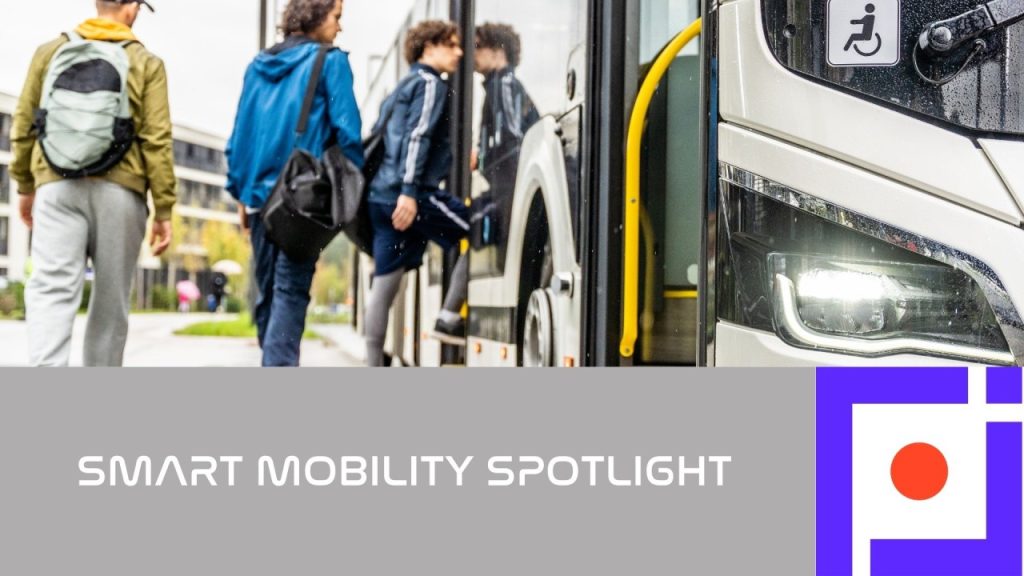
| Key Takeaways: • What is the primary driver of public transportation ridership? • How does adding vehicle types affect a mobility system? • What is the biggest limiting factor to how transit agencies deploy and scale their fleets? • Discover the secret tool for making shared, high-occupancy transit run more efficiently. |
Celebrating World Public Transport Day
April 17, 2026 marked the first ever World Public Transport Day. Announced by UITP at the launch of the United Nations Decade of Sustainable Transport, the day was designed to celebrate the role buses, trams, metros, and trains play in connecting people to jobs, education, healthcare, and opportunity. More than 200 organizations across every inhabited continent participated. In Europe alone, public transport moves nearly 60 billion passengers every year, and every Euro invested in it generates four Euros in wider economic value. It is, by any measure, one of the most efficient systems cities have ever built. And yet, by many of the same measures, it is also one of the most underused. So, what is actually standing between public transport and its potential, and what would it take to close that gap?
🚌 The Mode that Carries Cities and the Gap It Cannot Close
Public transport is today more recognized than ever as an essential component of quality urban life. It reduces congestion, lowers emissions per person, expands access for populations who cannot use private vehicles, and makes cities economically more productive. The case for public transportation is actually overwhelming. And yet, ridership has not recovered from pandemic-era lows. According to UITP‘s Global Economic Outlook 2024, which surveyed 111 transit operators and transport authorities across 47 countries, more than half remain below their pre-pandemic ridership levels. North American metro, bus, and light rail systems remain 45 percent below 2019 figures. The operators themselves identify the problem clearly: the primary driver of ridership is not fare policy or urban growth, but service quality, specifically frequency, reliability, and travel time.
This is not a new finding. Research from the Congressional Research Service confirms that the most effective strategy for attracting riders is reducing travel times by increasing service frequency, rather than simply expanding access to stops and stations. A UK study found that increasing bus frequency from four to six buses per hour on a single route was projected to deliver a 20 percent ridership increase in year one alone! The relationship between operational quality and ridership is well documented. Unfortunately, the gap between that knowledge and what is actually delivered on the ground remains wide.
If the problem is so well understood, why has a decade of mobility innovation not solved it?
🚗 When Innovation Adds Vehicles, Not Value
The past decade has produced no shortage of mobility innovation. Ride-hailing platforms, micromobility services, and on-demand transit solutions have reshaped how cities think about movement. Yet much of this innovation has increased the number of vehicles on the road rather than the number of people moved efficiently through cities.
The evidence on this has been consistent for years. Research published in Nature Sustainability, conducted across major North American cities, found that the arrival of ride-hailing services did not replace private car trips as expected. Instead, they pulled riders away from buses and trains, reducing public transit ridership by 8.9 percent while simultaneously adding vehicles to already congested streets. A study published in Science Magazine went further, using six years of real trip data scraped directly from ride-hailing platforms in San Francisco. It found that ride-hailing was not just contributing to congestion but was its single largest driver, responsible for a 62 percent increase in vehicle hours of delay between 2010 and 2016, far outpacing population growth, employment growth, or any other factor studied. Schaller Consulting‘s analysis of Uber and Lyft across US cities found that the dynamic was structural, not incidental: for every mile of personal driving removed, ride-hailing companies added 2.6 new vehicle miles to city streets, largely due to empty vehicles repositioning between trips.
The pattern is consistent across studies and cities. Adding vehicle types to a mobility system does not automatically improve how that system moves people. In some cases, it actively undermines the modes that do.
📊 The Number that Changes the Conversation
Underlying much of this data is a question that rarely gets asked directly: how many people are actually inside each vehicle moving through a city at any given moment?
Research from Stanford University published in December 2025 quantifies the answer in practical terms. The key variable in urban transport efficiency is not the type of drivetrain, the fuel source, or the level of automation. It is occupancy, how many people share each vehicle-kilometer traveled. By this measure, electric buses outperform private cars as soon as they carry more than two passengers, and approach subway-level efficiency with nine or more riders on board. The same analysis found that shifting even 20 percent of car passenger-kilometers onto well-used electric transit in a city the size of New York could generate energy savings in the hundreds of billions of joules annually. The physics of shared motion are not complicated. Moving more people per vehicle is the most direct lever available to cities. The challenge is operational. Which raises the question: why are cities still struggling to pull that lever?!
🔧 Improving How Systems Run, Not Just Where They Go
This distinction, between expanding a system and improving how it performs, matters much more than you might think. The ITF Transport Outlook 2023, published by the OECD – OCDE, models two futures: one where private vehicle mode share in urban areas falls from 49 percent today to 36 percent by 2050 through bolder policy, and one where it does not. The difference is not primarily infrastructure. It is whether cities can make public transport reliable enough, frequent enough, and flexible enough to compete with private alternatives on the terms that actually matter to riders.
The Texas A&M Transportation Institute 2025 Urban Mobility Report found that Americans lost an average of 63 hours sitting in traffic in 2024, the highest figure ever recorded, and that delays are no longer confined to traditional rush hours. Cities are adding congestion without adding vehicle capacity. The bottleneck is not roads or rail lines. It is the ability to run high-frequency, consistent services without the operational constraints that have historically limited how transit agencies deploy and scale their fleets.
🤖 Autonomy and the Public Transport Opportunity
Autonomous technology has real potential to change how public transport operates, specifically on the operational challenges identified in the preceding paragraphs. Driver costs represent one of the largest expense items in any transit agency’s budget. Research published in Taylor & Francis Group found that removing this cost constraint could enable more frequent service, particularly in underserved areas where current staffing costs make high-frequency operation economically unviable. A separate study on autonomous bus deployment in Stockholm found that autonomous buses have the potential to attract more passengers specifically through improved service provision, with frequency being the primary lever.
Beyond cost, autonomous systems also allow routes and schedules to be adjusted more dynamically than traditional transit planning cycles allow, making it easier for operators to respond to where demand actually exists. The opportunity, in other words, is not autonomy as a new category of vehicle, it is autonomy as a tool for making shared, high-occupancy transit run more efficiently. Specifically, desired outcomes are more departures, more consistency, lower cost per trip, and faster response to where riders actually need service.
🚍 Imagry’s Approach: Autonomy Built for Operational Impact
At Imagry, we see the challenge of public transport not primarily as an infrastructure problem, but as an operations problem. Frequency, reliability, and coverage are the levers that move ridership, and they are exactly the levers that autonomous operations are positioned to improve, when the technology is designed for transit environments rather than adapted from individual vehicle use.
Imagry’s solution offers several key advantages for public transit agencies and fleet operators:
- No infrastructure adjustments required Our AI-based approach removes the need for LiDAR, HD maps, dedicated roadway modifications, and geofencing restrictions. This allows for faster deployment and reduces the upfront costs typically associated with autonomous systems.
- Built for shared operations The platform is optimized for predictable, high-frequency services such as shuttles for fixed routes, where operational efficiency and utilization are highest.
- White-label flexibility The system is fully brand-agnostic, enabling car sharing agencies and fleet operators to deploy autonomous services under their own identity.
World Public Transport Day is a moment to recognize what public transport already delivers, and to examine what it still needs to become. The gains are not going to come from adding more vehicles. They are going to come from making shared systems smarter, faster, and more reliable. That is the work worth celebrating today, and the work worth investing in tomorrow!
Autonomous Mobility News & Events
Click here to see the latest news and events featuring Imagry’s autonomous driving solutions.
Autonomous Mobility Video Spotlight
At the European AV Summit in London, Imagry CEO Eran Ofir was invited to share the company’s real-world experience deploying autonomous public transportation solutions on public roads. Watch this video to learn how Imagry is bringing real-world autonomy to public transport for M3 / M2 / M1 category vehicles.
Autonomous Mobility Career Opportunities
We’re building more than autonomy. We’re building a team that dares to do what others say is impossible.
We value people who chase hard problems not credit. Who ask better questions. Who stay curious. Who care about the mission, not job titles. And we know that to build the future, we need all kinds of minds.
If that sounds like you, we’d love to meet you.
Want to receive information about automated mobility on a regular basis?
Next stop, full autonomy!
Are you coming? Got a question for us?
Company Locations
1630 Oakland Rd.
Suite #A112
San Jose CA 95131
USA
53 Derekh HaAtsma'ut
5th Floor
Haifa 3303327
Israel